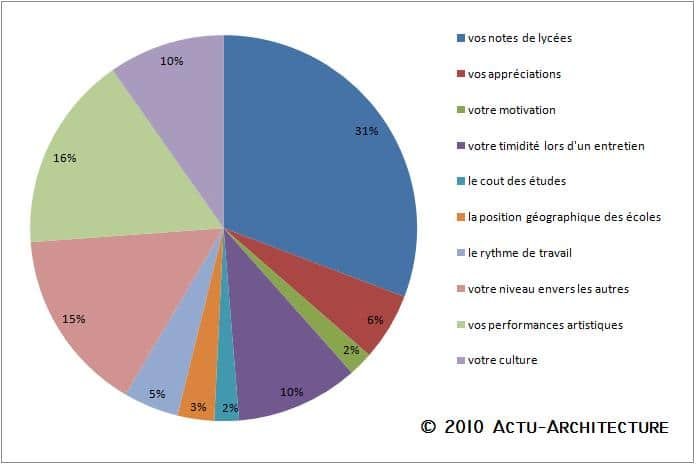
A little before Christmas, I launched a survey among applicants to architecture schools, and it’s time to share the results. Candidates could select two answers out of the ten proposed. The results presented here exclude the 65 blank responses and only account for the 195 completed ballots.
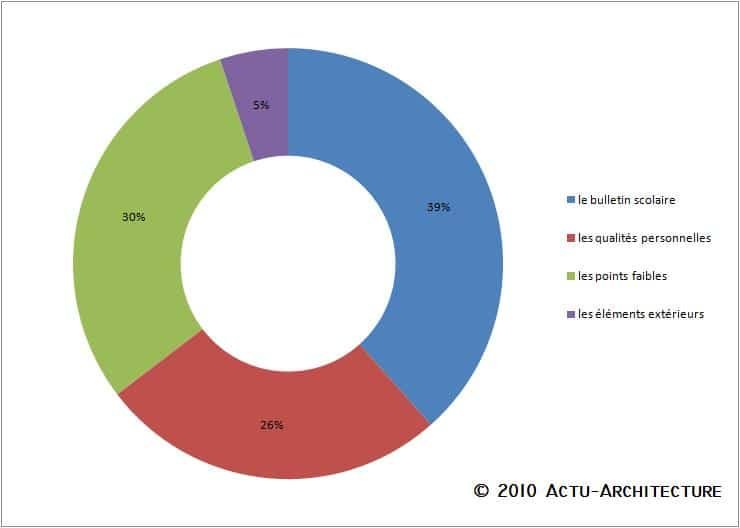
In my second chart, I grouped the different options into four categories. It shows clearly that external factors such as the school’s location or its cost do not scare applicants, even if one can expect about €30 per month for model-making expenses. It’s also reassuring to see that school grades do not overwhelmingly dominate; other factors such as culture and artistic sensitivity are well represented. This proves that architecture is not a profession that can be reduced to A+B=X, but a field deeply connected to life. As Victor Hugo said: “Architecture is the great book of humanity, the principal expression of man across the various stages of his development, whether as force or as intelligence.”
Despite strong motivation, the acceptance rate for schools averages around 10%, which pushes many to think about a plan B. Some high school students turn to MANAA programs; others choose a year of art history at university, though I don’t think that’s the best choice. Two other common paths seem to me both justified and interesting: the BTS Design d’Espace, which builds artistic creativity along with drawing skills; and the DUT Génie Civil, which provides a pragmatic view of architecture, construction techniques, and practical know-how. This approach strengthens project feasibility and can lower costs – Renzo Piano and Richard Rogers even said that the Centre Pompidou would have been much cheaper if they had known these construction tricks at the time. Still, failing the admission exams isn’t a disaster. Some schools deliberately prefer more mature candidates rather than high school graduates. This period can be an opportunity to explore other interests and develop one’s cultural background: architecture is not only architecture, but also photography, painting, music, cinema, theatre, etc. Travel is also highly valued by admission juries.
This year, architecture schools adopted the “admission post-bac” procedure, the government platform for post–high school orientation. The pre-registration phase ends on March 20. After that, each school is free to choose its own selection method. Most – like the schools in Nantes or Lille – conduct interviews, while others such as Lyon or Grenoble organize written exams. These may include a drawing test, a culture and architectural history test, and a technology test. Grenoble also has the particularity of selecting 40 applications directly without an interview.